dinsdag, juni 20, 2006

Cheap Viagra Big Dicks


In the yawning chasm of every woman's
dream there must seem that burning question
of what the world will do
when all the viagra has been consumed
and all the dicks are hard forever.

Some say it's been done before
without the cheap hieroglyphics
of buying drinks and reading minds
or deciphering whose baby
will be whose baby
will beget another baby
nobody wants
for all those viagra erections

but yet the spam keeps coming
as if by dulling the senses
we will be aware of the finer
qualities of hard ons
and all their noble purposes.

I don't want a life long dick.
I don't need a permanent erection,
I don't need to satisfy a woman
24 hours a day because neither of us
will be interested that long.

So keep your cheap viagra big dick bucks
for the kind of people who don't know
when enough is enough
and leave the rest of us
to find love.

vrijdag, mei 19, 2006

Fate


I killed time by walking as though boredom is a bomb waiting to go off
once motion stops.

I began with short forays, circles around neighbourhoods with the
spirals outward growing gradually. You could be utterly ignorant of
history and still wonder through timeless unfamiliarity, overcome by the
senses – Albert would’ve had to page through a myriad of history books
and start each jaunt knowing precisely where he planned on ending up
simply because that’s how he went about travelling. But I was content
to move in a dreamlike sequence, imagining history without the facts,
piecing it together from the stories I imagined overhearing,
conversations I couldn’t understand in family-run cafés, butchers,
cheese mongers and tobacconist shops.

Infatuation has a way of weaving its way into every moment, every sight
and sound, every impression and no matter how far I walked, I was
dreaming in this web about a future with Anastasia spent here – that I
barely knew her or her habits made little difference as I tiled together
a mosaic of future moments walking those same streets, the moments and
sights and experiences conjured up from an imaginary future with no
basis in reality, no matter the wishing or dreaming it were already so.

I tried to rationalise that this was simply a temporal experience,
following temptation, morsels of Anastasia left like crumbs throughout
the day to nibble on. I knew at the bottom of the barrel there would
nothing left eventually – in love we are like little lab rats doing the
predictable in order to enforce the norm.

There was only walking and dreaming and when once noon had come and gone
I knew it would be time to head back to her flat, that she’d already be
awake, drawn gradually back to consciousness by coffee with a tiny shot
of anisette.

And when I returned, there was no cause for further dreaming because
there I was, living the very dream I’d been walking through – a punctual
kiss and back to the business of waking for already I was learning that
nothing could be forced upon her and it was better still to leave the
hints and suggestions to her lest those dreams start leaking from my
head out of my mouth and into her ears and the entire hideous charade
was exposed.

zondag, mei 14, 2006

Battle of Pavia


The Battle of Pavia was a continuation of the Italian Wars which began in 1494. Renaissance Italy was divided into several rival states, hostage to European powers, principally France and Spain. Swiss mercenaries held the balance between two great civilizations, that of the south and that of the north. (A relic of this historic position is the continuation of the Pope's Swiss guard down to this day.)

Francis I, King of France, in alliance with the Venetians, had achieved a hard-fought victory over the Swiss cantons at the Battle of Marignano, near Milan, on Sept. 13-14, 1515. This fiercely-fought battle excited all Europe, was referred to as the "Battle of Giants," and represented the first serious check suffered by Swiss arms, due largely to combined arms tactics by the French and their used of large numbers of relatively modern cannon, although the Swiss were only moved to retreat when the Venetian army arrived on their rear on the second day of the battle.

In 1525, Pope Clement VII became alarmed at the control of Naples and Lombardy by Emperor Charles V. So the Pope formed an alliance with the victor at Marignano, Francis I, who returned over the Alps with a new army of 26,000 French, Italian, Swiss, and German soldiers. The campaign began brilliantly with the capture of Milan and Francis' triumphal entry. Marching on to Pavia (20 miles south of Milan), Francis dawdled in laying siege to the city. The Habsburg Emperor retaliated by sending a 23,000-man Habsburg army under Fernando Francisco de Avalos, Marchese di Pescara, to support the 6,000-man garrison in lifting the siege.

from wikipedia....

zaterdag, mei 13, 2006

Pacing The Bird


One afternoon we were walking and as we walked she started telling me about this Parisian girl named Amélie Hélie, a singer at the beginning of the 1900s. She was nicknamed the Casque d’Or for her lengthy, golden hair. The leaders of two rival bands in the neighbourhood, the Corsican Leca and his rival, Manda, both fell in love with her, madly, brutally. Their competition for her eventually grew into a big battle one day on this very street, rue de Haies. A big battle with knives and guns. They were arrested and then appeared before the magistrate. The magistrate keeps badgering Manda about why the battle grew in the first place, refusing to believe that it wasn’t over neighbourhood territory, but a girl. Manda said something to the magistrate like, we fought each other, the Corsican and me, because we love the same girl. We’re crazy about her. Don’t you know what it is to love a girl?

So what happened I asked, thinking the magistrate saw the logic of the explanation and let them free to fight some knightly battle for the girl’s hand. We both had stopped walking and were simply standing off to the side of the street as passersby dodged us.

I think Manda got life and Leca got many years and they were both deported off to hard labour.

Hmmm. Magistrate frowns on violent demonstrations of love?

Something like that, but worse still, after all of this…she paused, waiting for me to light her cigarette. A friend of Leca, seeking revenge for his comrade, stabbed Amélie one night in the club where she sang. She didn’t die, but she could no longer perform as a singer. She’s buried at Bagnolet. Sometimes it isn’t sufficient in life not to let yourself fall in love because letting someone else fall in love with you can have equally damning consequences.
Who Are These Fuckers And How Did They Get Here?


Albert says the judge was lenient. We had a little joke in the court room. Either that or she was trying to find the motivation for my seemingly random anarchistic and criminal act. What are you dreams, she asks me at the sentencing. I gave her several different scenarios. To tread water until my limbs grow too tired to tread anymore and I drown. I thought I was being clever. She shook her head. Are you still finding this a joke, she asks me, incredulous. No, it isn’t funny at all your honour, I sincerely don’t have any dreams. Not dreams that would be rendered coherent in an incoherent society anyway, your honour.

You said that? I took another swig of the pint, these repetitive motions were all part of communication in the world Albert and I were sitting in. He nodded his head enthusiastically. So what did she say?

Nothing for a minute. Silence. Summing me up in her head. Clearly she was impressed by me in some indefinitive way she was quickly trying to calculate. Would it be more helpful if I told you it was my dream to be the guy who assembles display furniture all day long at an Ikea factory outlet mall? Then her eyes were like little slits, comprehending I wasn’t taking my sentencing seriously at all. What did I care anyway. I know the maximum sentencing guidelines. I wasn’t a murderer, I hadn’t committed a violent felony. Four years maximum, free food, regardless of how shitty it might be, the experience of prison, time to work on my book, I could have gone on all afternoon about the exciting possibilities a small prison sentence would have afforded me.

By then, the judge wasn’t interested in any of my answers. She’d tried a tact, tried to be humane. Inexplicably, while my public defender representative turned white with incredulity, she became almost jocular, leaned over the front of the bench. Too ambiguous, she stated, nearly inaudible and very slowly as though I had some sort of learning disability rather than genius.

How about an interpretive dance, done with feeling and emotion, I offered. But the game was over. She slammed the gavel down, suddenly impatient and poof, sentencing was on. Do you know how many times I told that fucking story to my cell mate? How many variations, how many different tenses, different languages, different angles I’ve created that story into, sheerly out of boredom?

He pinched out his cigarette with an annoyed look on his face. I’ll tell you something Witold. It wasn’t as bad as you might imagine jail to be. No rapings, no beatings from prison guards. A lot of long hours with nothing to do. It drives some people crazy but for me, it was three years to think

dinsdag, mei 09, 2006

Feet


...But this is a good time to reflect on how dusty,
scarred by worn sandals, dirty between the toes, grime
on the calloused soles, the apostles' feet would have been.
And mind moves on to worse: old winos stumbling along,
unwashed, their long nails thick as horn, shoes wrong-sized, broken.
And not just winos — anyone homeless, who has to keep moving all day
with no place to go, even if shelter at night
gives them a chance to bathe their blisters, must know
week by week an accretion of weariness, once-good shoes
grown thin...


— from "Feet," by Denise Levertov

more poems by Denise Levertov

zondag, april 30, 2006

The Blank Vote


José Saramago, one of DT's favourite authors, says in a recent interview that "the world is governed by institutions that are not democratic - the World Bank, the IMF, the WTO. People live with the illusion that we have a democratic system, but it's only the outward form of one. In reality we live in a plutocracy, a government of the rich."

His solution is one which can be fully and thoughtfully embraced, the only exciting political idea I've heard in the last two years (other than impaling Bush and Blair and sticking their heads on pikes on the streets of London and DC respectively...)

"...we, as citizens, do have the power of the vote, but we always use it to vote for one or other of the parties on off er. But there is another possibility, which is to cast a blank vote.' He leans forward and points a stern finger. 'And this is not at all the same as abstention. Abstention means you stayed at home or went to the beach. By casting a blank vote, you're saying that you understand your responsibility, you have a political conscience and you came to vote, but you don't agree with any of the existing parties and this is the only way you have of saying so."

read more of Saramago's interview...

zaterdag, april 29, 2006

At Your Service


Genoeg het nooit, de uitzicht
van een verkortende gracht
die stikkenden en bloemen mee draagt?
Te sterven op de betamelijk moment,
liggende in stakende volgorde
met kaarsen en verwelkende
verkiezingsaanplakbiljetes,
de versterkende herinneringen --
totdat de hekken van de Kathedral,
die een strengende, statig held opgerecht hebben?

De schreeuwende waarheid
is door de straten gedraagt,
verminkt door een escadrille van media,
authentiekte in de bejaardenthuis
van de achter kamer politici,
verraad bij verraad,
totdat
barsten de ooken,
barst de bobble van woede;
een brandstapel van menselijke dromen,
die door kijkcijferonderzoekers de assen
verzamelt zijn.

Zij rouwen en massa;
insinuaties, schuldigers, ongelovingers:
een nieuwe geshiednis zonder herkenbaarende
straten, een kaartje van bedreigingen,
toeschouwers en kandidaaten.

Het genoeg nooit,
droefheid die szo orkestriert is,
de manipulatie neemt zijn eigen slachtoffers mee;
te scheppen of stukmaken
is de vrede vraag.
Museum of Russian Vodka


"A figure in monastic robes catches the eye of a visitor at the Museum of Russian Vodka near Izmailovo Market. The museum moved to Moscow from St. Petersburg and had its new grand opening this week. Its exhibits tell the story of vodka starting in the 15th century, when it was distilled in monasteries. Visitors can enjoy vodka tastings in a room decorated like a 19th-century traktir, or inn. The museum is in the white-towered "kremlin" at Izmailovo, near Partizanskaya metro station, and is open daily from noon to midnight. Photograph by Michael Eckels." via The Moscow Times

*****


Beer


1 In those old days which poets say were golden --
2 (Perhaps they laid the gilding on themselves:
3 And, if they did, I'm all the more beholden
4 To those brown dwellers in my dusty shelves,
5 Who talk to me 'in language quaint and olden'
6 Of gods and demigods and fauns and elves,
7 Pan with his pipes, and Bacchus with his leopards,
8 And staid young goddesses who flirt with shepherds:)

9 In those old days, the Nymph called Etiquette
10 (Appalling thought to dwell on) was not born.
11 They had their May, but no Mayfair as yet,
12 No fashions varying as the hues of morn.
13 Just as they pleased they dressed and drank and ate,
14 Sang hymns to Ceres (their John Barleycorn)
15 And danced unchaperoned, and laughed unchecked,
16 And were no doubt extremely incorrect.

17 Yet do I think their theory was pleasant:
18 And oft, I own, my 'wayward fancy roams'
19 Back to those times, so different from the present;
20 When no one smoked cigars, nor gave At-homes,
21 Nor smote a billiard-ball, nor winged a pheasant,
22 Nor 'did' her hair by means of long-tailed combs,
23 Nor migrated to Brighton once a year,
24 Nor -- most astonishing of all -- drank Beer.

25 No, they did not drink Beer, 'which brings me to'
26 (As Gilpin said) 'the middle of my song.'
27 Not that 'the middle' is precisely true,
28 Or else I should not tax your patience long:
29 If I had said 'beginning,' it might do;
30 But I have a dislike to quoting wrong:
31 I was unlucky -- sinned against, not sinning --
32 When Cowper wrote down 'middle' for 'beginning.'

33 So to proceed. That abstinence from Malt
34 Has always struck me as extremely curious.
35 The Greek mind must have had some vital fault,
36 That they should stick to liquors so injurious --
37 (Wine, water, tempered p'raps with Attic salt) --
38 And not at once invent that mild, luxurious,
39 And artful beverage, Beer. How the digestion
40 Got on without it, is a startling question.

41 Had they digestions? and an actual body
42 Such as dyspepsia might make attacks on?
43 Were they abstract ideas -- (like Tom Noddy
44 And Mr. Briggs) -- or men, like Jones and Jackson?
45 Then nectar -- was that beer, or whisky-toddy?
46 Some say the Gaelic mixture, I the Saxon:
47 I think a strict adherence to the latter
48 Might make some Scots less pigheaded, and fatter.

49 Besides, Bon Gaultier definitely shows
50 That the real beverage for feasting gods on
51 Is a soft compound, grateful to the nose
52 And also to the palate, known as 'Hidgson.'
53 I know a man -- a tailor's son -- who rose
54 To be a peer: and this I would lay odds on,
55 (Though in his Memoirs it may not appear,)
56 That that man owed his rise to copious Beer.

57 O Beer! O Hodgson, Guinness, Allsopp, Bass!
58 Names that should be on every infant's tongue!
59 Shall days and months and years and centuries pass,
60 And still your merits be unrecked, unsung?
61 Oh! I have gazed into my foaming glass,
62 And wished that lyre could yet again be strung
63 Which once rang prophet-like through Greece, and taught her
64 Misguided sons that the best drink was water.

65 How would he now recant that wild opinion,
66 And sing -- as would that I could sing -- of you!
67 I was not born (alas!) the 'Muses' minion,'
68 I'm not poetical, not even blue:
69 And he, we know, but strives with waxen pinion,
70 Whoe'er he is that entertains the view
71 Of emulating Pindar, and will be
72 Sponsor at last to some now nameless sea.

73 Oh! when the green slopes of Arcadia burned
74 With all the lustre of the dying day,
75 And on Cithæron's brow the reaper turned,
76 (Humming, of course, in his delightful way,
77 How Lycidas was dead, and how concerned
78 The Nymphs were when they saw his lifeless clay;
79 And how rock told to rock the dreadful story
80 That poor young Lycidas was gone to glory:)

81 What would that lone and labouring soul have given,
82 At that soft moment for a pewter pot!
83 How had the mists that dimmed his eye been riven,
84 And Lycidas and sorrow all forgot!
85 If his own grandmother had died unshriven,
86 In two short seconds he'd have recked it not;
87 Such power hath Beer. The heart which Grief hath cankered
88 Hath one unfailing remedy -- the Tankard.

89 Coffee is good, and so no doubt is cocoa;
90 Tea did for Johnson and the Chinamen:
91 When 'Dulce est desipere in loco'
92 Was written, real Falernian winged the pen.
93 When a rapt audience has encored 'Fra Poco'
94 Or 'Casta Diva,' I have heard that then
95 The Prima Donna, smiling herself out,
96 Recruits her flagging powers with bottled stout.

97 But what is coffee, but a noxious berry,
98 Born to keep used-up Londoners awake?
99 What is Falernian, what is Port or Sherry,
100 But vile concoctions to make dull heads ache?
101 Nay stout itself -- (though good with oysters, very) --
102 Is not a thing your reading man should take.
103 He that would shine, and petrify his tutor,
104 Should drink draught Allsopp in its 'native pewter.'

105 But hark! a sound is stealing on my ear --
106 A soft and silvery sound -- I know it well.
107 Its tinkling tells me that a time is near
108 Precious to me -- it is the Dinner Bell.
109 O blessed Bell! Thou bringest beef and beer,
110 Thou bringest good things more than tongue may tell:
111 Seared is, of course, my heart -- but unsubdued
112 Is, and shall be, my appetite for food.

113 I go. Untaught and feeble is my pen:
114 But on one statement I may safely venture:
115 That few of our most highly gifted men
116 Have more appreciation of their trencher.
117 I go. One pound of British beef, and then
118 What Mr. Swiveller called a 'modest quencher';
119 That home-returning, I may 'soothly say,'
120 'Fate cannot touch me: I have dined to-day.'

Charles Stuart Calverley

zaterdag, april 22, 2006

I Played Music For A Gardener


you can play god for a second.

And you're sitting down
because you don't need to stand up
to do anything.

And there will be a gardener
sweating and pulling up YOUR weeds,
and you will still be sitting there

watching, with slanted god eyes
unable to mask your cynicism
thinking to yourself
by god, they're out there
gardeners,
another world
they play god in,
growing shit,
fostering shit,
harbouring shit,
putting me to shame
because flowers don't protest
and vegetables don't stage uprisings.

The gardener isn't even sweating.

Yet pull and mow and grow
Yet pull and mow and grow.

And from god's window,
you're watching. Testing
the product, this humanity growing
things.

You could get pissed off
at being upstaged,
you could express rage
in broken humanity roadside
yet instead
you open god's window
and let Coltrane breathe.

7:29 AM

zaterdag, april 15, 2006

Capitulo lagrimoso

Sì come al nascer piansi i’ vo piangendo,

E cusì pianger fin morte conviene,

Che in pianto un mal principio va sequendo.

Piansi in fasce, nel latte, & quando dieme

Nel petto il colpo Amor, piansi & hor piango

Per spezar quel che in duro pianto tieme;

La man con denti miei piangendo frango

Che nel dar fin son pigre al lungo pianto,

Del qual per pianger mai scarso rimango.

Piango perché nel ventre non fui franto,

Piango che fuor di quel nei teneri anni

Morte non posse il pianger mio da canto;

Piango quel dì che agli amorosi inganni

Lusingando fui perso; e piango il loco

Che fu principio dil mio pianto e danni.

Piange il solaccio, il suono, il canto e il loco,

Le rime e i versi; e piango il primo sguardo

Dove causò il mio lungo pianto e foco.

Piango perché non fu di tosco il dardo,

Piango perché né un serpe la catena,

Ché piangendo al morir non seria tardo.

Piango perché la fronte alma e serena

Non mi fu nel dur pianger di Medusa,

Ch’io sarei fuor di pianto e fuor di pena.

Piango la fiamma che gran tempo chiusa

Tenuta ho dentro il petto, e piango il laccio

Che piangendo mi fa l’alma confusa.

Piango il dur pianto, la ferita e il laccio,

Piango che uscir poeta di pianto amaro

Entrai piangendo qual huom scioccho e paccio;

Piango ch’io non conobbi il scur dal chiaro,

Piango che scorto fui da un finto aspetto,

Cusì piangendo ale mie spese imparo.

Piango senz’alma e senza cor nel petto,

Pien de pianto, suspir, de affanno e stento,

Dove piangendo stesso m’ho in dispetto;

Piango i miei tristi dì spesi in tormento,

Piango le notti che al fin scorto m’hanno,

E piango mie fatiche sparse al vento.

Piango il fidel servir mio senze inganno,

Piango mia pura fede, e il raro amore,

Piango miei persi pasi e il longo affanno.

I’ piango gli anni, i mesi, i giorni e l’hore,

Ché piangendo hanmi a cotal grado scorto

Ch’io son de pianto herede e senza core.

Piango il lungo martir e il gaudio corto,

Anci piango non altri che me stesso,

Che piangendo mi fei de vivo morto.

Piango che al tristo fin mi sento appresso,

Piango e piangendo in pianto più me accendo,

Ché per mio eterno pianto ha il ciel premesso

Che qual nacqui tapin mora piangendo.

--Giovanni Meli
Opera nova amorosa de Nocturno Napolitano

nb: the curious path to getting to Sicilian poet Giovanni Meli began with an article in the Guardian about how Bernardo Provenzano was finally tracked down after 43 years on the run.

Within the article it was mentioned that his wife was from Cinisi, which was "the muse of the renowned Sicilian poet Giovanni Meli, who has been in the small town between 1767 and 1772 to do his work as county doctor. There he composed some of his best lyrics looking at beautiful sea of Sicily that washes the coasts of cinisense coastal."


*****

Memories of Serge via the Guardian..


Serge and Jane Berkin, 1971

"We sat there patiently waiting until the air was suddenly rent with horrible screaming sounds followed by a cacophony of Gallic swearing. The owner of the cinema had just informed Gainsbourg in the lobby that he was entering a no-smoking zone and the great man had thrown a royal fit. Five minutes later he entered the room, his face lost in a dense fog of cigarette smoke - the owner was carrying a huge ashtray and stood next to him like his eunuch flunky catching the ash as it fell - and stumbled to the podium. He looked absolutely terrible - his face and body utterly polluted from alcohol abuse, his eyes ugly unfocussed slits, his voice a sneerful rasping whisper. He began to tell an obscene story involving Brigitte Bardot and a champagne bottle but he was too drunk to remember the ending so he staggered offstage, literally collapsing into a nearby seat. Everyone else gave him a standing ovation but I just sat there, stunned. I'd never seen anything quite like this: a beloved icon who'd lost all self-control and who was making an ignominious public spectacle of himself over and over again and yet his public wasn't repelled in the least. On the contrary, they couldn't seem to get enough of watching his continued self-abasement."

*****


Ultra Kultura specializes in alternative and extreme forms of literature. Sex and drugs feature prominently in its books -- but not much more so than in many recent Russian movies. It tends to favor anti-establishment authors, such as National Bolshevik Party founder Eduard Limonov. The head of the publishing house, Ilya Kormiltsev, is a poet with some cult standing, thanks to his work on the lyrics of the rock band Nautilus Pompilius. After the news broke, he challenged Chuyev to a debate on the talk show "To the Barrier," but the deputy declined, citing, among other reasons, his unwillingness to "advertise Kormiltsev and Ultra Kultura for a nationwide audience."

donderdag, april 13, 2006

"If you want to build a ship, don't herd people together to collect wood and
don't assign them tasks and work, but rather teach them to long for the
endless immensity of the sea."
- Antoine de Saint-Exupery


*****

Highway Drunk


Part One

Hey, it's fast at the edge of this bed.
They gave us coupons out of customs
and set copious whores in front of us
just to test our powers of self-empowerment.

We zipped through like the world was wet paper,
a vegetable to boil, a sad flesh to erase.

They called us in for being cheap:
Love costs. Ante up.

So we gave what we didn't know, artifacts
lost in socks and all those secret places
never poked,

and gave love because we read a USA Today poll
that confirmed what we thought.

Taken home, to the home owners,
through the corridors of the home offices,
back to the home away from home before stopping
at the "hey, homey!" holy ghost and Sunset,

We ratted them out, in succession,
for a Tom Waits twist and a mojo session.

We didn't wait to be tortured
in a comparative transgression.

We just went down.
On them, to a death they remember
in mid-orgasm:
Oh, The Money!, Oh, The Plowing Brahmans!
in order,
and then left,
a little less than sated.


Part Two

In Mexico, they drink
until the world stills. That's right, silent.
The dogs in the garbage cans know they're dead:
A Verdi cancellation underneath the puddle of a moon.

By now, it's been minced
into the drinking water and sung
on popular radio stations.

They fed us our love in sushi portions,
tv dinner infatuations,
one moment to the next,
Max Planck sperm knocking down the quantum walls
into egg and then to zygote.

But we didn't dare believe them.
They made us hungry like Siberian winters
And ate our flesh to manifest themselves.

In our unattended lectures, they went on
as kindled captains dying checkmate hopes
on gratis skewers:
Here They Come! Here They Come!

And then in Mexico we out Fox'd them,
with canon hearts exploding rules
that plastered walls with boredom.

Once again, because we weren't sure ourselves.


Part Three

When we creep between two worlds,
the ligaments and the livid,
we whine an incarceration of lifetimes
like the deaf relying on floor vibrations
to hear the music.

When they come for us with totebags,
dressed in suits of information to collect
our wandering lusts,
to burn our lonesome effigies,
into obligatory dust
we must

take the Highway Drunk,
like prisoners off chain gangs after freedom's
gushy feast:
ignore the placards drooling in our wanted faces,
the isolated moments jitter
their own handicaps,
their own dilemmas.

And when they want love,
give them unlimited space to hang themselves.


Part Four

Part Four:

Ishmael warned us it was better
to sleep with a sober cannibal
than a drunken Christian
and then he fell asleep with Queequeg.

Our moments of perfection lie in
lucid mommies milking
flawless childhoods to fruition.

We've learned to love what
we've learned to shave
to a mere transluscence;
a garlic razor sliver second
when we are transfixed.

So give up the sexy breasts,
the milking tit,
the nights in irrefutable transition:

Here it is, the dawn chafing,
a child howling,
a simple miscommunication.

The world forgives only
what you choose to feed it.

maandag, april 10, 2006

Let Op!


Katten kunnen het vogelgriepvirus verspreiden!

*****

New Nepalese Dentistry Programme Nets Plenty of Teeth


Ouch....

woensdag, april 05, 2006

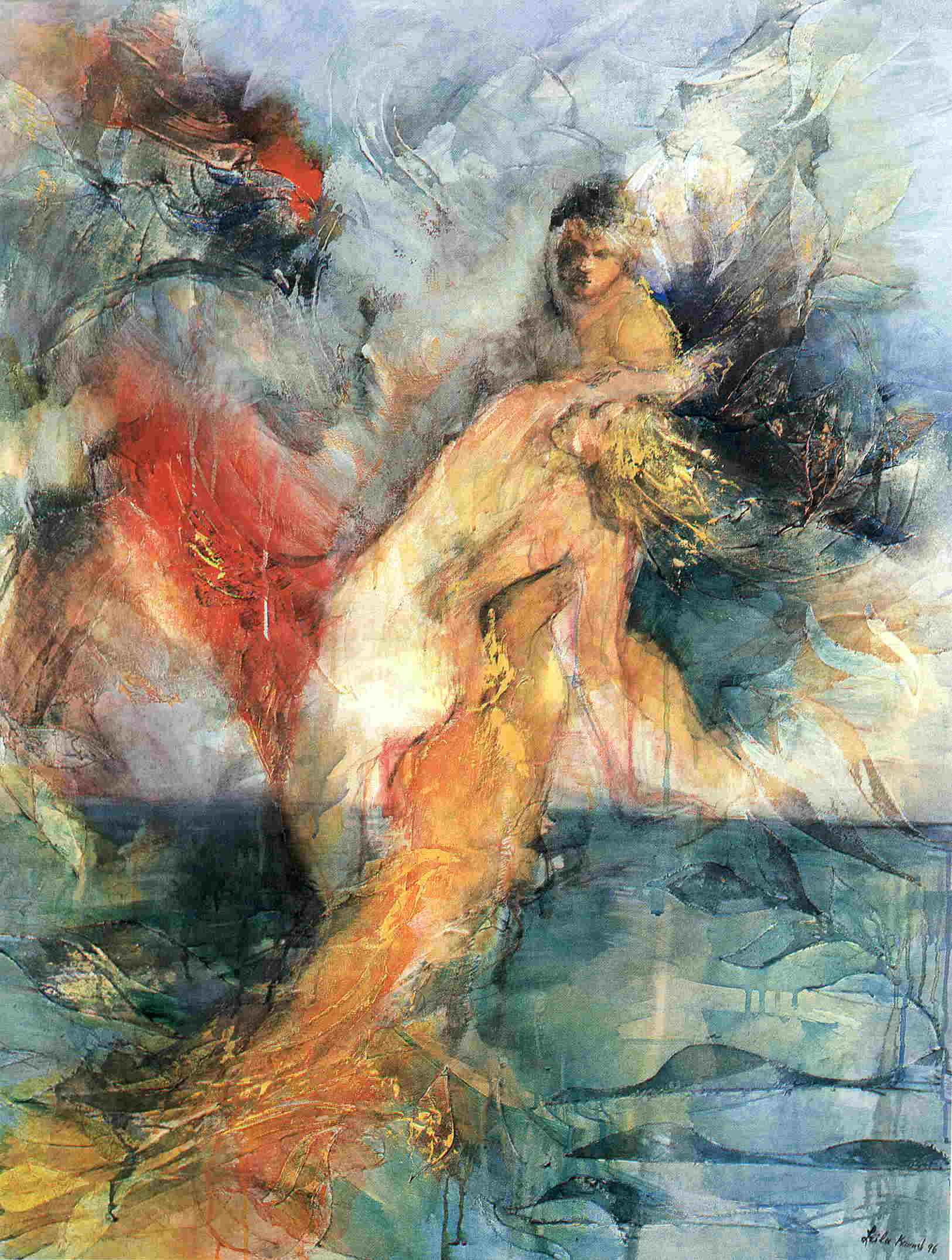
Man Cursing the Sea


(image: Leila Kubba Kawash 1996.)

Someone
just climbed to the top of the cliffs
and began to curse the sea.

Dumb water, stupid pregnant water,
slow, slimy copy of the sky,
you peddler between sun and moon,
pettifogging pawnbroker of shells,
soluble, loud-mouthed bull,
fertilizing the rocks with your blood,
suicidal sword
dashed to bits on the headland,
hydra, hydrolizing the night,
breathing salty clouds of silence,
spreading jelly wings
in vain, in vain,
gorgon, devouring its own body,

water, you absurd flat skull of water--

And so he cursed the sea for a spell,
it licked his footprints in the sand
like a wounded dog.

And then he came down
and patted
the tiny immense stormy mirror of the sea.

There you go, water, he said,
and went his way.
--Miroslav Holub. Trans. David Young & Dana Habova.
from Sagittal Section. 1980

vrijdag, maart 31, 2006

Loch Ness Monster


Not much for concert announcements but this should be a good one. Tix go on sale 2day.

woensdag, maart 29, 2006

Puedo Escribir Los Versos...


Puedo escribir los versos más tristes esta noche.

Escribir, por ejemplo : 'La noche está estrellada,
y tiritan, azules, los astros, a lo lejos'.

El viento de la noche gira en el cielo y canta.

Puedo escribir los versos más tristes esta noche.
Yo la quise, y a veces ella también me quiso.

En las noches como ésta la tuve entre mis brazos.
La besé tantas veces bajo el cielo infinito.

Ella me quiso, a veces yo también la quería.
Cómo no haber amado sus grandes ojos fijos.

Puedo escribir los versos más tristes esta noche.
Pensar que no la tengo. Sentir que la he perdido.

Oir la noche immensa, más inmensa sin ella.
Y el verso cae al alma como al pasto el rocío.

Qué importa que mi amor no pudiera guardarla.
La noche está estrellada y ella no está conmigo.

Eso es todo. A lo lejos alguien canta. A lo lejos.
Mi alma no se contenta con haberla perdido.

Como para acercarla mi mirada la busca.
Mi corazón la busca, y ella no está conmigo.

La misma noche que hace blanquear los mismos arboles.
Nosotros, los de entonces, ya no somos los mismos.

Ya no la quiero, es cierto pero cuánto la quise.
Mi voz buscaba el viento para tocar su oído.

De otro. Será de otro. Como antes de mis besos.
Su voz, su cuerpo claro. Sus ojos infinitos.

Ya no la quiero, es cierto, pero tal vez la quiero.
Es tan corto al amor, y es tan largo el olvido.

Porque en noches como ésta la tuve entre mis brazos,
mi alma no se contenta con haberla perdido.

Aunque ésta sea el último dolor que ella me causa,
y éstos sean los últimos versos que yo le escribo.

Pablo Neruda

vrijdag, maart 17, 2006

Once More For The Auld Boys


Fernando Pessoa is the extreme example of what may be the essentially modern kind of poet: the objective introvert. None has more consistently tried to find his poems impersonal. He accepted the dividedness of a human self so completely that he did something unique: wrote poetry under four names - his own and three 'heteronyms'. Not pseudonyms: they are imagery poets with real poems in them. Fernando Pessoa was four poets in one: Alberto Caeiro, Ricardo Reis, Alvaro dos Campos and himself; each strongly distinct from the others.

donderdag, maart 16, 2006

Looooouuuuu


It's not that I've ever been a Lou Piniella fan, but this photo seems to capture everything that is wrong with the world in one pair of eyes.

dinsdag, maart 14, 2006

Oblivion


(Korobushkin Evgeniy, "Oblivion". Oil on cardboard. 1990. 75x61)


"At the end of conversations, that precipice breached, the craving to be in
another culture gnaws at you. Go home to the bones. The carcass has been picked clean and thereafter, the only destination is oblivion."


from: The Diaries of Witold Kamerisky, notebook 12, page 113

zondag, maart 05, 2006

Poète, auteur et metteur en scène de théâtre...


"If our life lacks a constant magic
it is because we choose to
observe our acts & lose ourselves
in consideration of their imagined
form instead of being impelled by
their force."


— Antonin Artaud

*****

Paris de nuit, 360 degrees panoramic view...

*****

Meanwhile, US President Bush was over in Asia to give everyone yet another reason to burn flags and start riots and blow shit up.

Nice depiction by our fav cartoonist, Steve Bell, on Bush's visit to India:


(gracias, Fat Buddha

And when he'd had his fun in India, he was off to Pakistan to play some cricket against the (yes, unbelievable but true,)Islamabad College for Boys.


It's a wonder pity he was only hit once.